


On September 11th, at the 2026 China International Mining Congress, the China Mining News Agency released the "Global Mining Development Report 2026". The report pointed out that driven by the global energy transition, coupled with factors such as supply chain fluctuations and international rule games, the global mining industry is entering a period of overlapping changes characterized by the dominance of safety logic, the reshaping of technological revolution, and the reconstruction of governance rules.
In 2025, the global supply-demand structure of mineral resources underwent accelerated adjustment, with notable differences among different types of minerals: demand for energy minerals slowed down overall, with oil supply exceeding demand and natural gas production and consumption both rising simultaneously; bulk minerals showed varying trends, with steel supply decreasing while demand increased, copper and zinc supply and demand both increasing, and aluminum supply and demand both decreasing; strategic emerging minerals generally faced oversupply, with nickel and lithium surplus deepening; precious metals faced tight supply and demand, with platinum and silver in short supply and gold in tight balance.
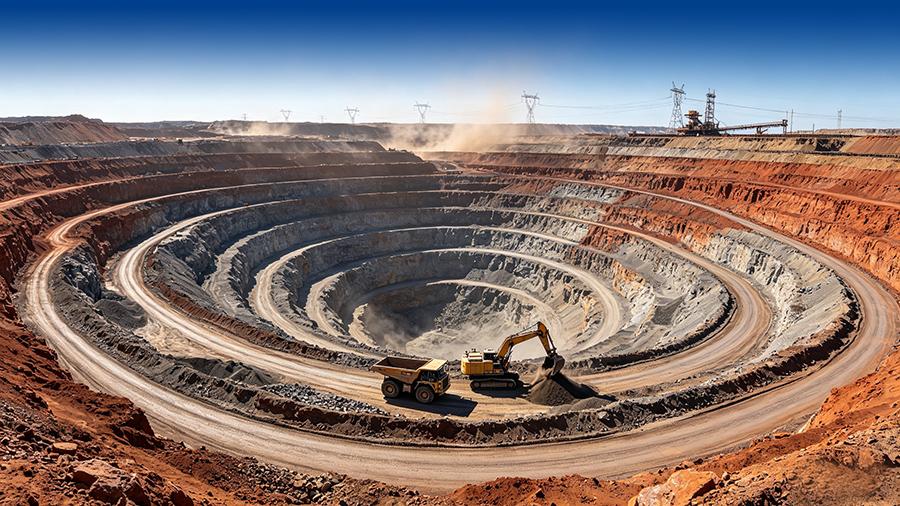
Challenges and opportunities coexist in the field of exploration and development. Data shows that in 2025, global investment in solid mineral exploration fell for the fourth consecutive year to USD 12.401 billion, with grassroots exploration shrinking to 20.8%, indicating pressure on resource continuity. Meanwhile, the drilling market bucked the trend, with drilling projects and the number of boreholes increasing by 9.9% and 31.2% year-on-year, respectively. The mining capital market is booming, with annual financing surging by 108.7% year-on-year and mergers and acquisitions transactions increasing by 150.4%. The pace of industry capital consolidation has noticeably accelerated. The price trends of old and new energy minerals are diverging, with traditional fossil energy prices under pressure and new energy minerals and precious metals experiencing significant price increases.
Global mining policy adjustments and technological transformations are accelerating simultaneously. Major developed economies are comprehensively deepening their key mineral security strategies, while resource-based developing countries continue to promote resource sovereignty and diversified cooperative interaction patterns. The process of intelligent and green mining is accelerating, with AI-based prospecting being industrialized, the construction of a "satellite-air-ground-well" three-dimensional detection system being expedited, and the popularization of unmanned mining, new energy support for mines, and closed-loop resource recovery technologies being accelerated.
The report fully demonstrates China's positive role in the global mining industry transformation. China adheres to open cooperation, mutual benefit, and win-win results, continuously deepening the mechanism of transnational mining cooperation. Technical equipment such as unmanned mining trucks, large-scale mine models, and tailings resource recovery contribute Chinese strength to the green and intelligent transformation of the global mining industry. The "International Economic and Trade Cooperation Initiative for Green Minerals" has been responded to by more than 20 countries and international organizations. Standards such as the "Sustainable Mining Code" have been implemented, and the world's largest green mine cluster has been built, providing a replicable practical model. Chinese mining enterprises adhere to localized operations and community co-construction in overseas projects, demonstrating corporate social responsibility.
The report calls on all countries to strengthen collaboration in the field of critical minerals, promote the establishment of an open, inclusive, fair, reasonable, cooperative, and win-win, green, and clean governance system for critical minerals, and jointly build a clean, beautiful, and prosperous world.
